Math at TLA Academy
Explore. Solve. Think. Discover.
TLA Academy’s Mathematics program helps learners build a strong foundation in math through hands-on exploration, meaningful practice, and real-world problem-solving. Students develop confidence with numbers and mathematical thinking while learning that there can be many ways to approach and solve a problem.

Course Overview
Mathematics learning activities focus on developing number sense, mathematical vocabulary, reasoning, and problem-solving skills.
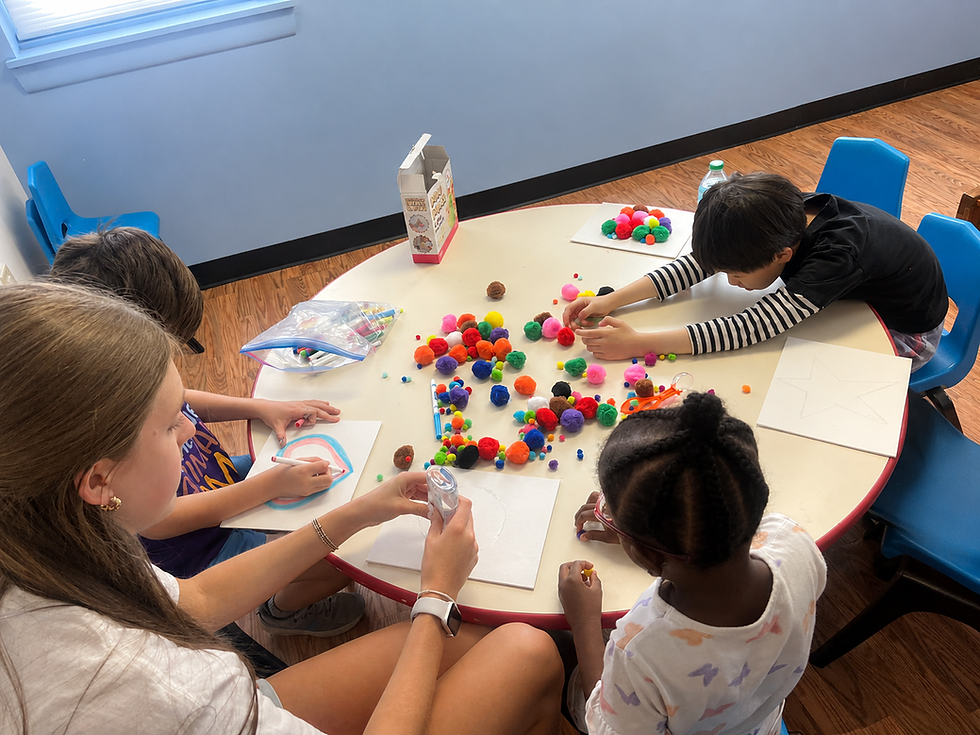
Instruction is adapted based on each learner’s existing skills and may include guided play, math conversations, sensory activities, games, manipulatives, visual models, real-world applications, and more traditional written practice when appropriate.
Rather than relying on worksheets alone, students have opportunities to see, touch, build, move, discuss, and apply mathematical concepts, helping them develop a deeper understanding of how and why math works.
Course topics are informed by the Virginia Department of Education Standards of Learning (SOL) while allowing flexibility to meet learners at their individual instructional levels.
What We’ll Explore
Students may work on:
-
Number Sense & Counting — understanding quantities, counting, comparing numbers, and recognizing numerical relationships
-
Addition & Subtraction — developing strategies for combining, separating, and working flexibly with numbers
-
Place Value — understanding how numbers are composed and represented
-
Patterns & Relationships — recognizing, extending, creating, and explaining patterns
-
Measurement — exploring length, weight, capacity, time, and other measurable attributes
-
Geometry & Spatial Thinking — identifying, describing, building, and comparing shapes and spatial relationships
-
Math Vocabulary — learning to understand and communicate mathematical ideas
-
Problem-Solving & Reasoning — developing strategies, making predictions, testing ideas, and explaining thinking
-
Real-World Math — applying mathematical concepts to money, cooking, building, games, schedules, shopping, and everyday experiences
What Learning Looks Like
Math at TLA is designed to be active, visual, hands-on, and meaningful.
A class might begin with a number talk or math warm-up, followed by a short teacher-led lesson. Students may then use manipulatives, games, sensory materials, building activities, movement, guided play, or written practice to explore the concept.
A typical lesson might look like:
Explore → Model → Practice → Problem-Solve → Share Our Thinking
Students are encouraged not only to find an answer but also to begin understanding how they arrived at it.
Math Beyond the Worksheet
Mathematics is naturally incorporated into experiences throughout the TLA day.
Students might measure ingredients during Life Skills, count and compare LEGO pieces, identify patterns in art, use a calendar during morning activities, collect data during science, work with maps during TLA World Travelers, or measure materials for a project.
These experiences help children understand that math is something we use—not simply something we complete on a worksheet.
Meeting Learners Where They Are
Students may enter the same classroom with very different mathematical abilities. TLA’s small-group model allows activities to be differentiated while students continue participating in shared learning experiences.
For example, during one activity, a learner may be counting objects and matching quantities to numerals, another may be solving addition problems with manipulatives, while another may be developing strategies for multi-digit calculations.
The goal is to strengthen each learner’s mathematical understanding from their individual starting point while building confidence, curiosity, and independence.
%20(1).jpeg)